Department of Animal Ecology, Lund University, SE-223 62 Lund, Sweden
Present address:
 pdf
pdf
 Measuring temperature in the forest duff on the left of image (plastic covered chart recorder to
protect from rain). Screen cages were for testing the survival of Ips typographus under
natural conditions.
Measuring temperature in the forest duff on the left of image (plastic covered chart recorder to
protect from rain). Screen cages were for testing the survival of Ips typographus under
natural conditions.
 as wind, humidity, and light intensity influence the degree
of flight initiation on a particular day.
as wind, humidity, and light intensity influence the degree
of flight initiation on a particular day.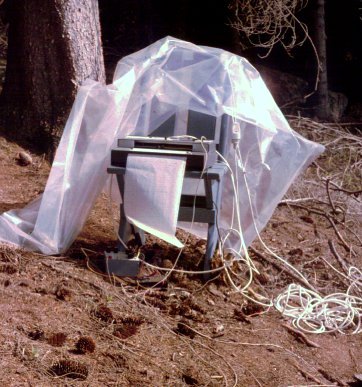 A four-probe electronic scanning thermometer (Byers
1984) was used to measure temperatures in Norway
spruce Picea abies litter during the spring dispersal
(swarming) period of I. typographus. The monitoring
site was 2 m from the nearest tree on the outside of
nearly pure spruce forest (50-70 yr old) about 15 km
NNE of Skien, Norway. The integrated circuit probes
(3x4x5 mm) were placed in the spruce needle duff at
the depths shown in Figs lA and B. The surface-probe
rested on the needles and was exposed to the sun, but
the air-probe (1 m height) was shielded with aluminum
foil that surrounded the sensor like a "bell". A one-pen
chart recorder was used to record the temperatures by
scanning each probe for 116 s.
A four-probe electronic scanning thermometer (Byers
1984) was used to measure temperatures in Norway
spruce Picea abies litter during the spring dispersal
(swarming) period of I. typographus. The monitoring
site was 2 m from the nearest tree on the outside of
nearly pure spruce forest (50-70 yr old) about 15 km
NNE of Skien, Norway. The integrated circuit probes
(3x4x5 mm) were placed in the spruce needle duff at
the depths shown in Figs lA and B. The surface-probe
rested on the needles and was exposed to the sun, but
the air-probe (1 m height) was shielded with aluminum
foil that surrounded the sensor like a "bell". A one-pen
chart recorder was used to record the temperatures by
scanning each probe for 116 s. Flight initiation or take-off attempts were monitored
electronically in cylindrical transparent plastic chambers
(14 cm diam x 18 cm high) with a phono-pickup and
amplification trigger-circuit that actuated a multi-channel
event recorder (Byers and Löfqvist, unpubl.). The
flight chamber floor was made from a plastic petri-dish
bottom (14 cm) on four foam rubber legs (1.5 cm). In
the chamber floor a metal-screen covered hole (8 cm
diam.) allowed ventilation, and 15 small take-off platforms
(6x6x6 mm) were glued to the screen floor (for
tlight without duff). Plastic photocopy transparencies
were formed into a tube and taped to form the chamber
sides. Eight fine-screen covered holes (1.5 cm diam) on
the chamber sides also allowed ventilation and equili-
bration of environmental conditions which were programmed
by a walk-in environmental chamber (12.6 m3;
Karl Weiss, Giessen, Germany). The plastic petri-dish
tops covered the top of the flight chambers and each
had a mono phono-pickup appressed to the top outside
center of the dish. Vibrations from flying beetles striking
the top and sides were usually detected by the system
(> 90% of flights were detected), although pickup
sensitivity differences make comparisons between
chambers less accurate than comparisons over time
within a chamber.
Flight initiation or take-off attempts were monitored
electronically in cylindrical transparent plastic chambers
(14 cm diam x 18 cm high) with a phono-pickup and
amplification trigger-circuit that actuated a multi-channel
event recorder (Byers and Löfqvist, unpubl.). The
flight chamber floor was made from a plastic petri-dish
bottom (14 cm) on four foam rubber legs (1.5 cm). In
the chamber floor a metal-screen covered hole (8 cm
diam.) allowed ventilation, and 15 small take-off platforms
(6x6x6 mm) were glued to the screen floor (for
tlight without duff). Plastic photocopy transparencies
were formed into a tube and taped to form the chamber
sides. Eight fine-screen covered holes (1.5 cm diam) on
the chamber sides also allowed ventilation and equili-
bration of environmental conditions which were programmed
by a walk-in environmental chamber (12.6 m3;
Karl Weiss, Giessen, Germany). The plastic petri-dish
tops covered the top of the flight chambers and each
had a mono phono-pickup appressed to the top outside
center of the dish. Vibrations from flying beetles striking
the top and sides were usually detected by the system
(> 90% of flights were detected), although pickup
sensitivity differences make comparisons between
chambers less accurate than comparisons over time
within a chamber.
| Tab. 1. Flight rates (number of flights beetle-1 d-1) of Ips typographus (30 males or 30 females) in chambers with either forest duff or bare floor at 25oC, 19:5 L:D photoperiod, and 80% r.h. (28-30 Oct., 1983). | ||||
| Day | No Duff | Duff | ||
|---|---|---|---|---|
| Male | Female | Male | Female | |
| 1 | 63.7 | 58.6 | 19.6 | 25.3 |
| 2 | 2.9 | 10.1 | 17.2 | 15.0 |
| 3 | 0 | 0 | 2.5 | 0.8 |


| Tab. 2. Comparison of survival and flight rates (adjusted for apparent number flying) of Ips typographus in chambers (each 25 males + 25 females) with fresh spruce tissue (bark slabs or twigs) or without food at 25oC, 19:5 L:D photoperiod, and 80% r.h. | ||||||||
| Day | ||||||||
|---|---|---|---|---|---|---|---|---|
| 1 | 2 | 3 | 4 | 5 | 6 | 7 | 8 | |
| 6 November 1983 Food: five bark slabs | ||||||||
| Number flying | 0 | 0 | 2 | 5 | 6 | 6 | 5 | 3 |
| Flights beetle-1d-1 | - | - | 45 | 56 | 56 | 61 | 35 | 38 |
| No Food | ||||||||
| Number flying | 44 | 27 | 6 | 1 | 0 | 0 | 0 | 0 |
| Flights beetle-1d-1 | 34 | 24 | 18 | 17 | 0 | 0 | 0 | 0 |
| 23 November 1983 Food: 6 twigs | ||||||||
| Number flying | 10 | 12 | 12 | 6 | 3 | 0 | 1 | 0 |
| Flights beetle-1d-1 | 32 | 29 | 12 | 5 | 3 | - | 0 | 0 |
| No Food | ||||||||
| Number flying | 27 | 3 | 1 | 0 | 0 | 0 | 0 | 0 |
| Flights beetle-1d-1 | 14 | 18 | 16 | 0 | 0 | 0 | 0 | 0 |
| 2 December 1983 Food: 8 twigs | ||||||||
| Number flying | 11 | 14 | 7 | 5 | 2 | 1 | 0 | 0 |
| Flights beetle-1d-1 | 36 | 11 | 8 | 3 | 4 | 0 | 0 | 0 |
| No Food | ||||||||
| Number flying | 36 | 12 | 3 | 0 | 0 | 0 | 0 | 0 |
| Flights beetle-1d-1 | 29 | 27 | 8 | 0 | 0 | 0 | 0 | 0 |


|
John A. BYERS and Jan LÖFQVIST Department of Animal Ecology, Lund University, SE-223 62 Lund, Sweden Present address:
|
|---|