J. A. BYERS1, G. BIRGERSSON2, J. LÖFQVIST1, and G. BERGSTRÖM2
1Department of Animal Ecology, Lund University, SE-223 62 Lund, Sweden
Present address:
2Chemical Ecology, Göteborg University, SE-405 30 Göteborg, Sweden
 pdf
pdf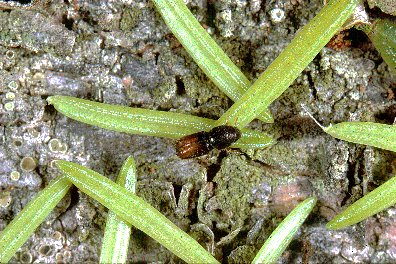 Pityogenes chalcographus male
looking for place to begin boring into bark of Norway spruce, Picea abies. Only males produce
aggregation pheromone.
Pityogenes chalcographus male
looking for place to begin boring into bark of Norway spruce, Picea abies. Only males produce
aggregation pheromone.| Table 1. Attraction of Pityogenes chalcographus to perforated cylinder traps releasing synthetic host ((+ )-alpha-pinene = (+ A), (- )-alpha-pinene = (- A), (- )-(B-pinene = (- B), and camphene = Cp) and pheromone components (methyl-E,Z-2,4-decadienoate = E,Z-MD and chalcogran = CH) in the forest (June 1-15,1986, Grib skov, Denmark). | |||||
| Attraction to cylinder trap | |||||
|---|---|---|---|---|---|
| Landing | Entering holes | ||||
| Chemicals releaseda | Total | Male proportion | Total | Male proportion | [ % ] |
| test 1 | |||||
| Blank | 1 | - | 0 | - | 0 |
| CH | 39 | 0.26 | 8 | - | 17.0 |
| E,Z-MD | 0 | - | 0 | - | - |
| E,Z-MD + CH | 1376 | 0.42 | 240 | 0.35 | 14.9 |
| test 2 | |||||
| E,Z-MD + CH | 123 | 0.46 | 7 | - | 5.4b |
| E,Z-MD + CH + (+A) + (-A) + (-B) + Cp | 482 | 0.40 | 338 | 0.35 | 41.2 |
| test 3c | |||||
| E,Z-MD + CH | 763 | 0.33 | 103 | 0.32 | 11.9b |
| E,Z-MD + CH + (+A) | 720 | 0.33 | 318 | 0.29 | 30.6 |
| E,Z-MD + CH + (-A) | 1476 | 0.33 | 815 | 0.28d | 35.6 |
| E,Z-MD + CH + (-B) | 1077 | 0.35 | 618 | 0.27d | 36.5 |
| E,Z-MD + CH + Cp | 749 | 0.33 | 208 | 0.24d | 21.7 |
| test 4 | |||||
| Blank | 4 | - | 0 | - | 0 |
| 0.1 x (E,Z-MD + CH) | 665 | 0.43e | 139 | 0.26 | 17.3 |
| 1 x (E,Z-MD + CH) | 1968 | 0.37 | 534 | 0.33 | 21.3 |
| 10 x (E,Z-MD + CH) | 2772 | 0.34 | 507 | 0.30 | 15.5 |
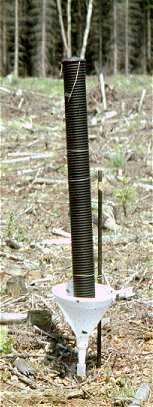 In the second test (Table 1), a
mixture of several host monoterpenes
that were released with the pheromone
components caused a significant increase in the proportion of both sexes
that entered holes in the cylinder trap.
Each of the various monoterpenes
when released with the pheromone
components also caused a greater percentage of both sexes to enter holes
(test 3, Table 1). These results indicate
that the monoterpenes, especially a
mixture, when released from a 12-cm
diam. cylinder can simulate a host tree
and induce hole-entering and thigmo-
tactic behavior in both sexes. (±)-alpha-Pinene, (-)-B-pinene, and camphene,
major volatiles of host oleoresin [2],
are thus used by P. chalcographus to
recognize its host during colonization.
The release rates used here are comparable to those released from infested
host material [2].
In the second test (Table 1), a
mixture of several host monoterpenes
that were released with the pheromone
components caused a significant increase in the proportion of both sexes
that entered holes in the cylinder trap.
Each of the various monoterpenes
when released with the pheromone
components also caused a greater percentage of both sexes to enter holes
(test 3, Table 1). These results indicate
that the monoterpenes, especially a
mixture, when released from a 12-cm
diam. cylinder can simulate a host tree
and induce hole-entering and thigmo-
tactic behavior in both sexes. (±)-alpha-Pinene, (-)-B-pinene, and camphene,
major volatiles of host oleoresin [2],
are thus used by P. chalcographus to
recognize its host during colonization.
The release rates used here are comparable to those released from infested
host material [2].|
J. A. BYERS1, G. BIRGERSSON2, J. LÖFQVIST1, and G. BERGSTRÖM2 1Department of Animal Ecology, Lund University, SE-223 62 Lund, Sweden Present address:
2Chemical Ecology, Göteborg University, SE-405 30 Göteborg, Sweden |
|---|